strategy · August 2026
When coding gets faster than the team: planning and collaboration in the age of AI agents
AI coding agents compress implementation time. This practical strategy guide shows how to redesign planning, ownership, review, architecture, governance, and team cadence so the whole engineering system can absorb that speed.
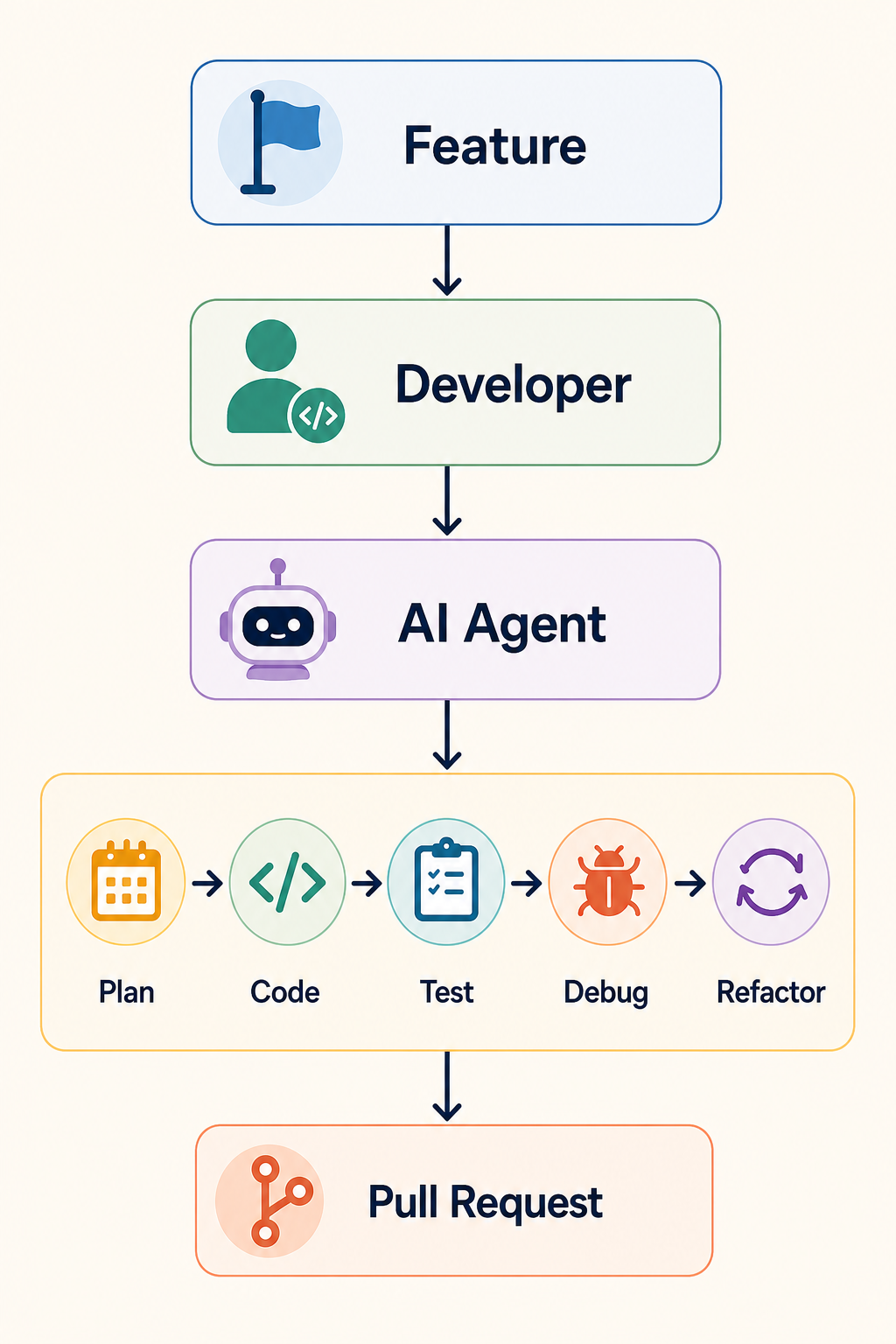
AI coding agents can now autocomplete, implement features, run tests, debug failures, refactor code, and open pull requests. That changes the economics of software delivery—but it does not remove the need for product judgment, architecture, review, security, or shared ownership.
AI compresses implementation time
A developer working with an agent can delegate a surprising amount of mechanical work: creating a service, wiring an API, adding persistence, generating validation, writing tests, updating telemetry, drafting documentation, and preparing a pull request. The agent can work while the team discusses the next product or architecture decision.
That is valuable, but it creates a mismatch. The code can arrive before the team has aligned on interfaces, failure modes, security boundaries, operational ownership, and how the change fits the larger system. Generation speed rises first; coordination capacity usually does not.
| Traditional constraint | With coding agents | New constraint |
|---|---|---|
| Implementation consumes much of the calendar. | Implementation can be parallelized or delegated. | Review, integration, testing, and decision quality become the pacing work. |
| The work queue naturally limits how much changes at once. | A single developer can consume a large backlog quickly. | The team must protect shared context and sequence change deliberately. |
| Code review is often close to implementation. | Review volume can arrive in bursts. | Review capacity, observability, and ownership need explicit design. |
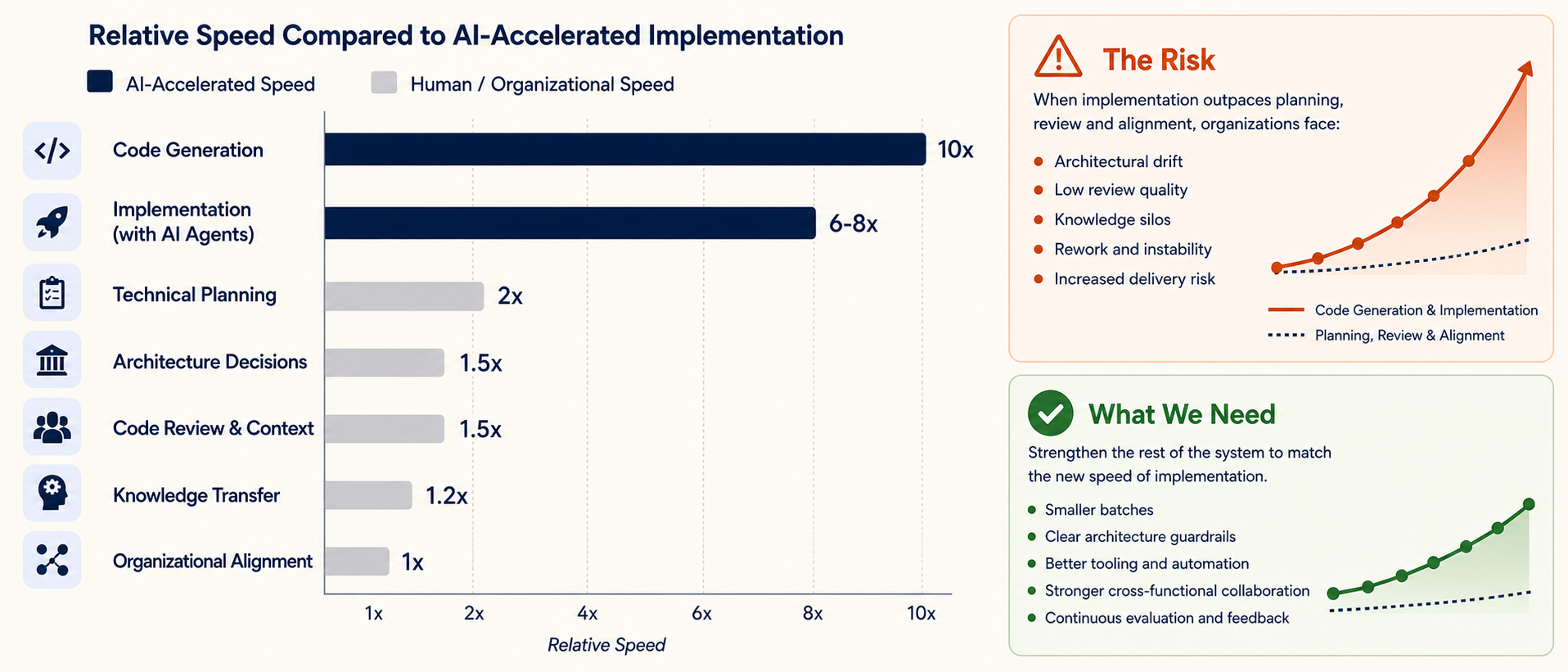
The team’s coordination clock has not sped up
Architecture discussions, product decisions, security reviews, integration work, operational readiness, and knowledge transfer still require people. When code generation outruns these activities, teams experience a new form of delivery pressure: implementation is ready, but the organization is not ready to understand, review, operate, or safely change it.
- Architecture alignment: interfaces, ownership boundaries, dependencies, and failure behavior.
- Product alignment: the user outcome, scope, acceptance criteria, and what is intentionally out of scope.
- Review and verification: test coverage, security analysis, performance checks, and evidence that the change works.
- Operational readiness: telemetry, alerts, rollback paths, runbooks, support impact, and cost.
- Knowledge transfer: enough shared understanding that more than one person can explain and safely modify the capability.
Planning has a half-life
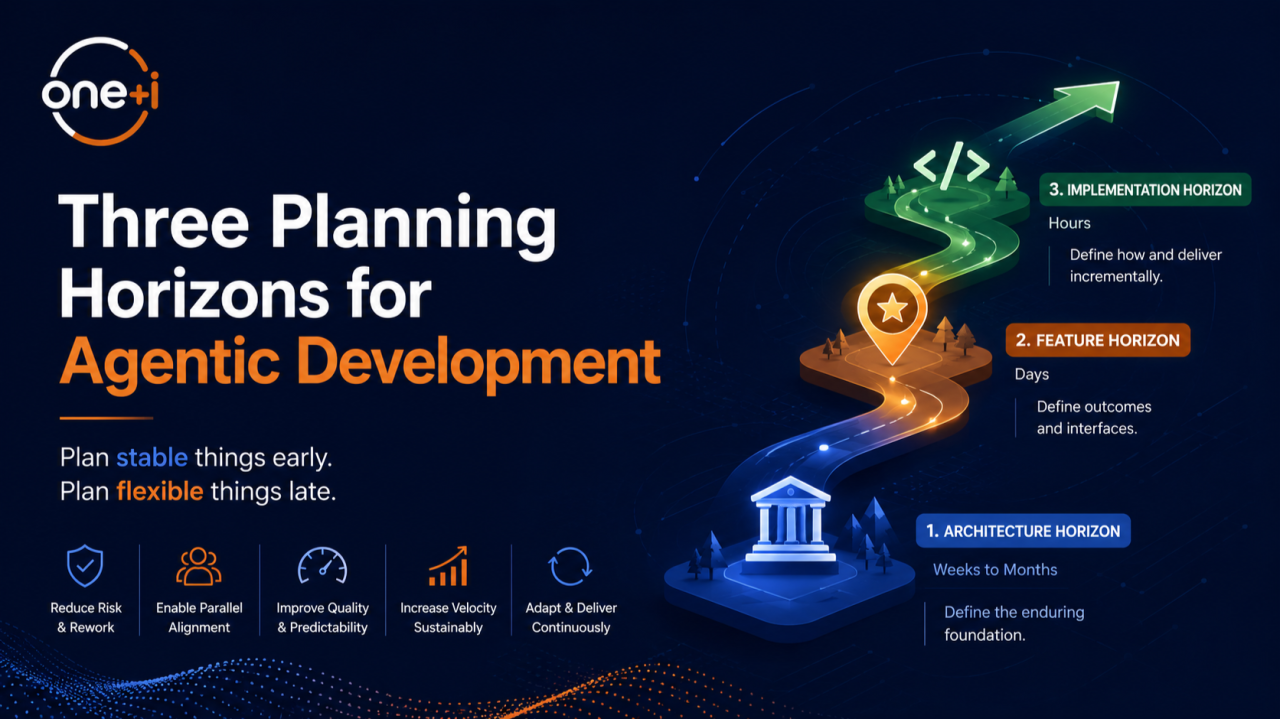
A useful planning model separates decisions by how stable they are. Architecture decisions should be made early because changing a public interface, data model, or ownership boundary is expensive. Feature decisions can stay closer to delivery, while implementation details should remain flexible until an agent and a developer can inspect the current code and choose the smallest safe change.
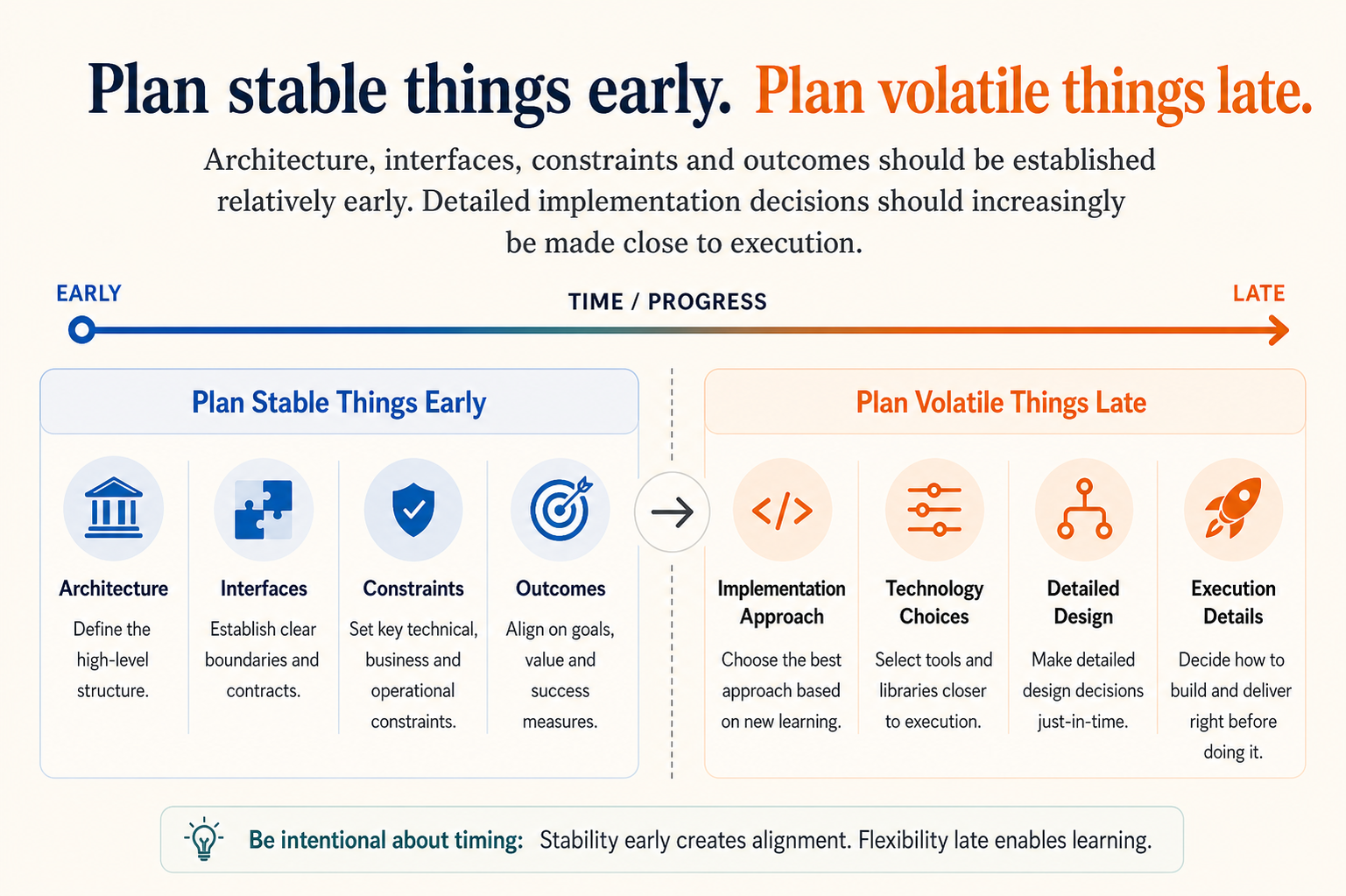
| Horizon | Plan early | Leave flexible |
|---|---|---|
| Architecture — weeks to months | Interfaces, constraints, ownership, data boundaries, reliability goals. | Detailed implementation and local abstractions. |
| Feature — days | Outcome, acceptance criteria, dependencies, rollout, observability. | Exact task decomposition and implementation sequence. |
| Implementation — hours | The change contract and verification expectations. | The safest code path, refactor shape, and agent prompts. |
A faster developer can consume the backlog
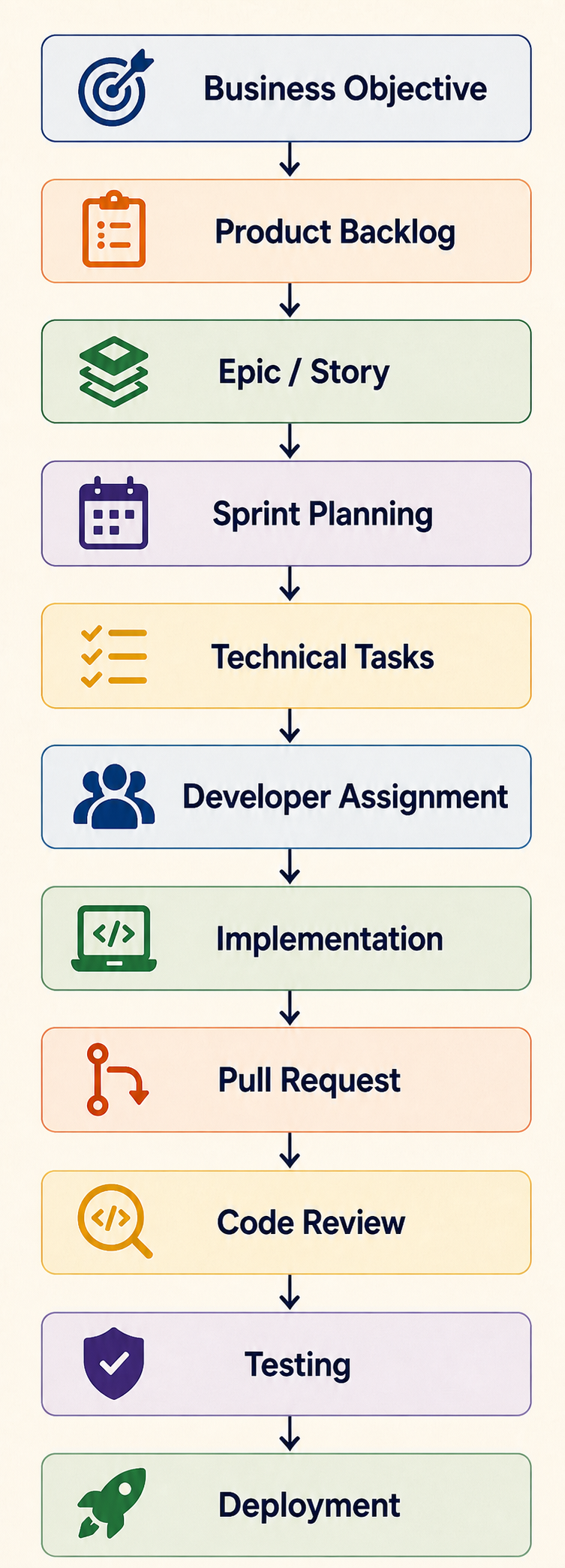
In a conventional workflow, implementation time creates natural coordination points. A developer finishes one task, asks a question, waits for a review, and the team has time to align. With an agent, one person can move through several tasks before anyone else has inspected the first change. This can make the team look productive while quietly reducing parallelism and increasing integration risk.
The danger is not speed itself. The danger is allowing a fast producer to become a serialized gateway through which every meaningful change, decision, and piece of system knowledge must pass.
Architecture can emerge from implementation
When agents implement features incrementally, architecture can be shaped by whichever local solution looked easiest at the time. No one explicitly decided to create another service boundary, duplicate a data transformation, or introduce a new integration pattern; the architecture simply emerged from a sequence of successful-looking changes.
Code generation is cheaper than understanding
AI lowers the cost of producing a plausible implementation faster than it lowers the cost of reviewing that implementation. Reading a large change, understanding why it exists, checking edge cases, validating security implications, and deciding whether it belongs in the system remain expensive human activities.
Small, coherent changes are therefore a control mechanism. Stacked pull requests, focused diffs, explicit contracts, and automated checks let reviewers reason about one decision at a time instead of reconstructing an entire feature from a giant patch.
Knowledge concentration creates a bus factor
A developer and an agent can become a highly effective but opaque pair. The developer knows the intent; the agent remembers the local context; the rest of the team sees a sequence of diffs. If that pair becomes the only source of knowledge for a production capability, the organization has created a silo even while increasing local throughput.
- Make feature ownership explicit, but avoid exclusive project ownership for important production capabilities.
- Require at least two humans to understand the interfaces, failure modes, and operating playbook for critical systems.
- Use design notes, decision records, meaningful pull-request descriptions, and runbooks as durable context.
- Rotate review and support responsibilities so knowledge moves through the team.
- Treat documentation and evaluation artifacts as part of the deliverable, not optional cleanup.
Where one developer and an agent are a good fit
A focused developer-agent pair is excellent when the blast radius is small, the outcome is clear, and verification is cheap. It is a poor substitute for collaboration when the work changes shared contracts or carries material operational risk.
| Good fit | Needs broader collaboration |
|---|---|
| Prototypes, spikes, internal tools, experiments, migrations, and small independent services. | Public APIs, shared data models, security-sensitive workflows, and cross-team platform changes. |
| Well-bounded tasks with deterministic tests and easy rollback. | Ambiguous product work, irreversible migrations, regulated decisions, and high-severity paths. |
| Changes that can be reviewed in a small diff. | Epics whose implementation choices change architecture or operating ownership. |
Feature contracts make speed legible
Before asking an agent to implement a feature, write a compact contract. It does not need to predict every task. It needs to make the outcome, boundaries, interfaces, and proof of correctness visible to everyone who will review or operate the change.
| Contract field | Question it answers |
|---|---|
| Outcome | What user or business result should improve? |
| Boundaries | What is explicitly in scope, out of scope, or forbidden? |
| Interfaces | Which APIs, events, schemas, or contracts may change? |
| Observability | What logs, metrics, traces, and alerts prove behavior in production? |
| Acceptance | Which examples, tests, and failure cases must pass? |
| Ownership | Who reviews, deploys, supports, and can roll the change back? |
Separate generation from evaluation
An agent is optimized to produce a candidate. The organization is responsible for deciding whether that candidate belongs in production. Keep those responsibilities visibly separate: the agent proposes and implements; automated checks and targeted evaluations challenge the change; humans make the acceptance and risk decision.
- Generate in small batches with a clear stopping condition.
- Run unit, integration, security, performance, and regression checks automatically.
- Use representative examples and failure cases, not only happy-path tests.
- Require human review for changes to critical interfaces, data access, policy, or irreversible state.
- Capture the evidence behind acceptance so later reviewers can understand the decision.
Redesign the operating model around shared ownership
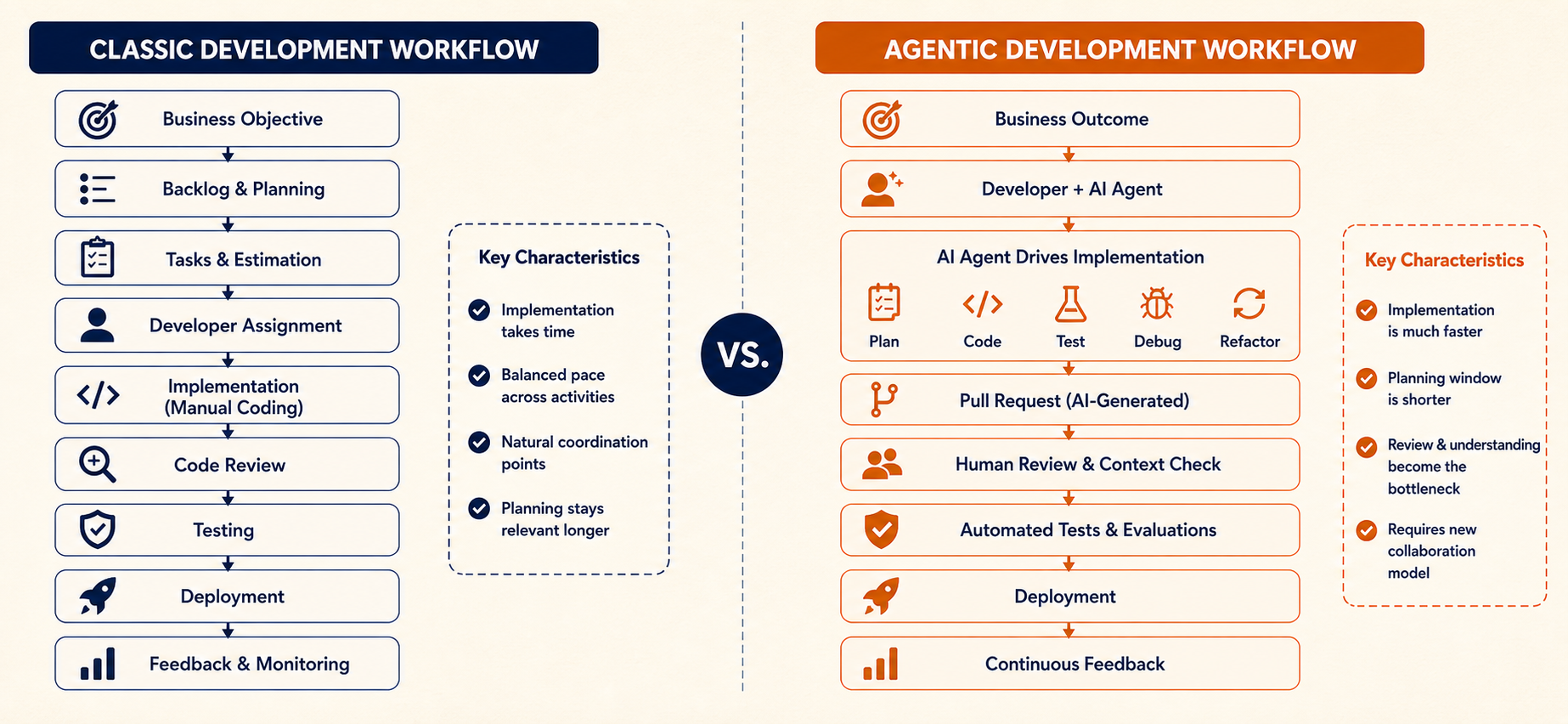
The unit of planning should move from “which developer gets which task?” to “which outcome, capability, and risk are we trying to improve?” Developers, product leaders, architects, security partners, and operators should align on the outcome and constraints, then let implementation proceed at the right level of autonomy.
- Short planning horizons: decide architecture and outcomes early; decide implementation close to execution.
- Small batches: make changes easy to review, revert, and learn from.
- Cross-functional review: bring product, security, operations, and domain expertise into the changes that need them.
- Explicit handoffs: define who approves, deploys, supports, and learns from each capability.
- Shared metrics: measure delivery speed alongside reliability, quality, knowledge flow, and user outcomes.
Security and governance are continuous
Agentic implementation increases the importance of least privilege, protected secrets, dependency scanning, code provenance, review gates, sandboxing, audit logs, and clear rollback paths. Governance should not be a launch ceremony after the code is complete. It belongs in the feature contract, the tool permissions, the CI pipeline, and the operating feedback loop.
Measure the system, not the fastest individual
A useful dashboard combines delivery, quality, coordination, and resilience. Lines of code or completed tickets can rise while the system becomes harder to change. Look for evidence that the team is learning faster without accumulating hidden risk.
| Dimension | Signals to track |
|---|---|
| Delivery | Lead time, batch size, cycle time, deployment frequency, time to restore. |
| Quality | Change failure rate, escaped defects, flaky tests, review rework, rollback rate. |
| Coordination | Review wait time, cross-team dependencies, ownership coverage, decision latency. |
| Resilience | Operational incidents, security findings, bus factor, runbook coverage, recovery confidence. |
| Value | User adoption, task completion, customer outcomes, cost-to-serve, and measurable business impact. |
References and further reading
LinkedIn: When Coding Gets Faster Than the Team ↗
A companion LinkedIn article on planning, collaboration, ownership, and delivery when AI coding agents compress implementation time.
DORA research: AI-assisted software development ↗
Evidence on how AI affects software delivery, throughput, stability, and the wider engineering system.
Stacked diffs at Google ↗
An engineering pattern for keeping large changes reviewable by breaking them into coherent, dependent diffs.
Effective harnesses for long-running agents ↗
Practical guidance on giving agents durable context, checkpoints, tests, and bounded execution over longer tasks.
AI Risk Management Framework ↗
A lifecycle framework for mapping, measuring, managing, and governing AI risks.
OWASP Top 10 for Large Language Model Applications ↗
A practical catalog of risks and mitigations for systems that use language models and agentic tools.