strategy · August 2026
From models to AI-native organizations: the evolution of AI strategy
A practical framework for moving from model selection to use-case portfolios, agentic workflows, enterprise capability, and the redesign of work.
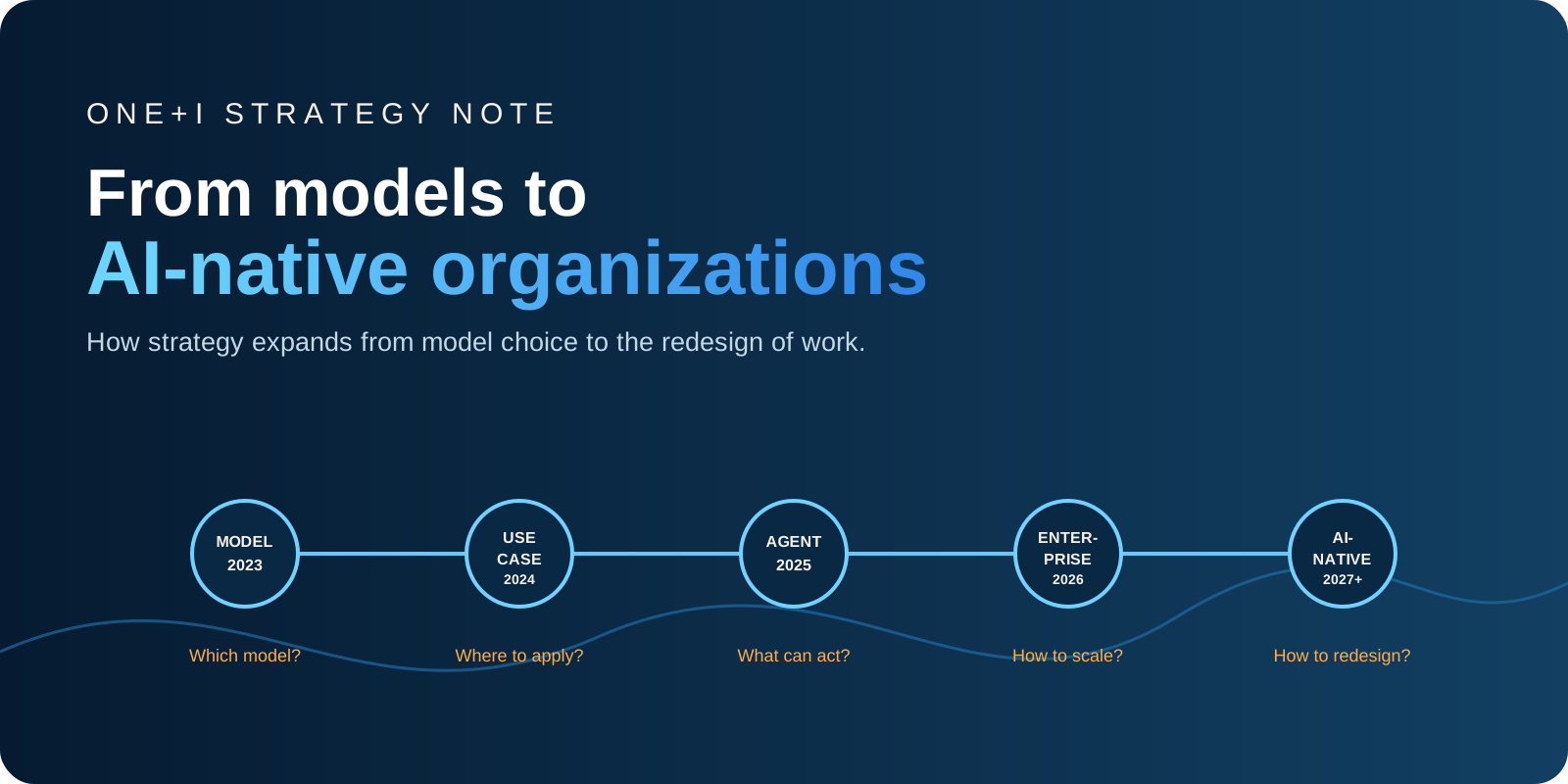
For much of the recent AI boom, organizations approached artificial intelligence as a technology to acquire. First came the scramble to understand large language models, then the search for compelling use cases, and then agents capable of performing work rather than only generating content. These are not isolated technology cycles: they are stages in the evolution of AI strategy.

AI strategy is no longer primarily about AI
As capable models become broadly available, the scarce advantage moves to the system around the model: proprietary knowledge, workflow integration, evaluation, adoption, governance, identity, and the ability to learn. Two companies can use the same foundation model and produce radically different outcomes because one has better context, processes, permissions, feedback, and operating discipline.
| Stage | Leadership question | Primary asset | Success measure |
|---|---|---|---|
| Model strategy | Which LLM should we use? | Model capability | Quality of generated outputs |
| Use-case strategy | Where can GenAI create value? | Applications and context | Useful, adopted workflows |
| Agent strategy | What work can AI execute? | AI-enabled workflows | Tasks completed within bounds |
| Enterprise strategy | How do we scale safely and economically? | Shared AI capability | Business outcomes and trust |
| AI-native strategy | How should the business operate with machine intelligence embedded? | Human-agent operating model | Durable competitive advantage |
Stage 1 — model strategy: which LLM should we use?
In 2023, model selection felt strategic because capability gaps were large and changing quickly. Leaders compared proprietary and open-weight models, prompting and fine-tuning, context windows, latency, data residency, security, hallucination rates, and token economics. Those questions still matter, but the model is not the product. Data, retrieval, application design, evaluation, user experience, and adoption determine whether model capability becomes business value.
Stage 2 — use-case strategy: where can GenAI help?
As access broadened, organizations built portfolios: customer-service assistants, contract analysis, engineering copilots, employee knowledge search, document intelligence, forecasting, and decision support. Retrieval-Augmented Generation became a strategic bridge between general models and proprietary knowledge: the system can retrieve current, governed evidence without retraining the model every time a policy or product changes.
Learn how modern RAG turns organizational knowledge into reliable context ↗
From pilots to a portfolio
A demonstration is not a transformation. “People like it” is not a sufficient ROI measure. A portfolio should balance productivity, revenue, risk reduction, capability building, and strategic differentiation. Score candidates on value, feasibility, data readiness, adoption readiness, risk, time to value, and scalability. Keep a small number of high-learning experiments, but stop experiments that do not close a measured failure or create a credible path to value.

Stage 3 — agent strategy: what workflows can AI execute?
A chatbot waits for a prompt; an agent can pursue an objective. The architecture shifts from human → AI → answer toward human → goal → agent → reasoning → tools → actions → outcome. That raises an organizational-design question: which parts of a workflow should be human, automated, or collaborative?
- Assist: AI retrieves evidence or drafts; a human performs the action.
- Recommend: AI proposes a decision; a human approves or rejects it.
- Plan: AI creates a sequence of actions; a human approves the plan.
- Execute with approval: AI acts after permission is granted.
- Execute with supervision: AI acts independently while humans handle exceptions.
- Autonomous operation: AI operates inside explicit policy, identity, budget, and shutdown boundaries.
Read the practical guide to bounded agent loops, tools, and human review ↗
Stage 4 — enterprise AI strategy: scale value safely
At enterprise scale, the hard problem is not one impressive application. It is turning dozens of experiments into coherent capability while maintaining economics, reliability, security, governance, and measurable outcomes. This requires a federated operating model: a central capability provides standards, model gateways, evaluation, security, and reusable infrastructure; domain teams own business problems, workflow design, domain data, user experience, and outcomes.

The capabilities that become strategic
Enterprise AI capability map
Curate data, metadata, permissions, provenance, and organizational memory for retrieval and agents.
Provide model routing, tool registries, identity, evaluation, observability, guardrails, and cost controls.
Train the workforce, redesign roles, and keep humans accountable for consequential decisions.
Use least privilege, approval gates, audit logs, monitoring, incident response, and safe shutdown.
Balance quality, latency, reliability, risk, and cost with model portfolios and FinOps.
Evaluation is operational infrastructure
Traditional software testing asks whether a system works. AI systems require a richer question: how well do they work under which conditions, and how do we know when behavior changes? RAG systems need retrieval, context, faithfulness, citation, and abstention measures. Agents add plan quality, tool choice, policy compliance, stop behavior, escalation, and business-outcome measures. Evaluation maturity determines how quickly an organization can experiment without losing trust.
Stage 5 — AI-native business strategy
AI-native does not mean a normal company with many AI tools. It means processes, architecture, workforce, and governance were designed around the availability of machine intelligence. Agents can monitor, retrieve, analyze, coordinate, and execute routine work; humans can concentrate more on judgment, accountability, relationships, ambiguity, strategy, creativity, and leadership.
The highest-value question is not “How can AI improve this process?” but “If intelligent systems were available from the beginning, would we design this process at all?” That question reveals unnecessary handoffs, duplicated data entry, meetings created to compensate for poor visibility, and approvals created only because information was difficult to coordinate.
A practical strategy playbook
- Name the ambition: define the competitive, customer, productivity, revenue, or risk outcome AI should change.
- Map the portfolio: compare initiatives by value, feasibility, data, readiness, risk, time to value, and differentiation.
- Choose one workflow: start with a real decision and a user who can validate whether the result is useful.
- Build the rails early: identity, permissions, evaluation, observability, cost controls, and human escalation are product requirements.
- Measure before scaling: establish a baseline and instrument quality, adoption, latency, cost, safety, and business outcomes.
- Redesign work: remove unnecessary handoffs instead of simply accelerating every existing step.
- Reinvest by evidence: scale what works, stop what does not, and use failures to improve the next cycle.
References and further reading
Stanford AI Index Report ↗
Annual evidence on model capability, adoption, economics, policy, and the broader AI ecosystem.
NIST AI Risk Management Framework ↗
A practical framework for governing, mapping, measuring, and managing AI risk across the lifecycle.
NIST Generative AI Profile ↗
Generative-AI-specific risk considerations for trustworthy design and deployment.
Anthropic — Building effective agents ↗
A practical distinction between workflows and agents, with guidance on tool use and orchestration.
McKinsey — The State of AI ↗
Research on enterprise adoption, value realization, scaling barriers, and agentic experimentation.
Microsoft Work Trend Index ↗
Research on human-agent collaboration, workforce change, and the redesign of organizational work.
One+i — Learning RAG from foundations to production ↗
A hands-on guide to retrieval, context engineering, evaluation, and production RAG systems.
One+i — Building AI agents from loops to teams ↗
A practical learning path for bounded agent loops, tools, teams, and human oversight.