GenAI & LLMs · August 2026
Evaluating RAG systems beyond the demo
A practical, state-of-the-art guide to measuring retrieval, context, grounded generation, citations, judges, robustness, and production performance.
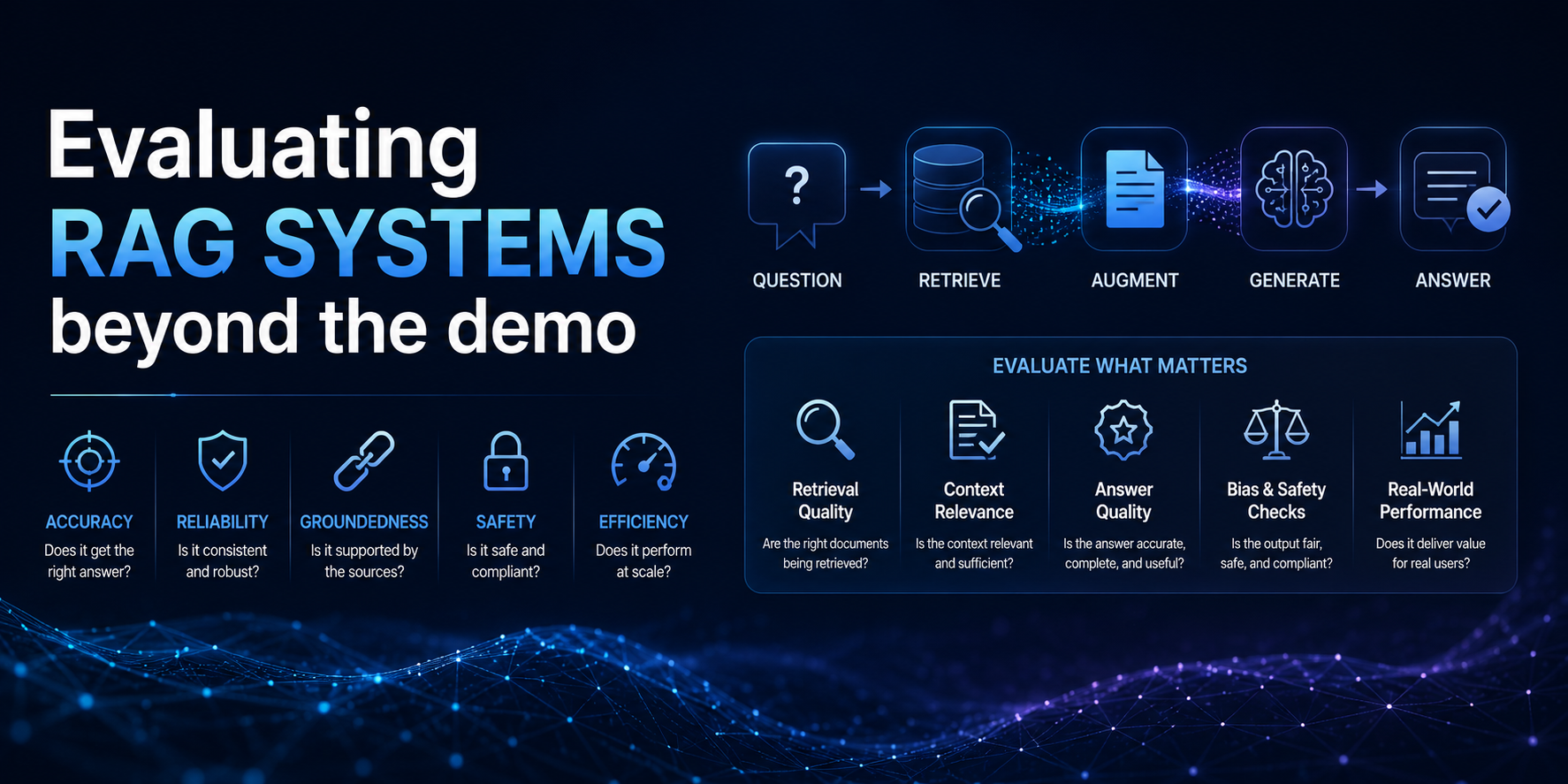
A RAG demo can look excellent while hiding a weak retrieval layer, noisy context, unsupported claims, broken citations, unsafe behavior, or production latency that makes the system unusable. Modern RAG evaluation is therefore not a single score. It is a diagnostic discipline: where did the answer come from, why did the system trust it, and what failed when the answer was wrong?
The current evaluation landscape has moved beyond “retrieval plus hallucination checks.” Serious teams now evaluate the pipeline as a system: ingestion, chunking, retrieval, reranking, context construction, generation, citation, judge reliability, robustness, security, cost, latency, monitoring, and—for agentic RAG—the decision process that decides whether to search again or stop.

1. Define what “good” means before measuring anything
A production RAG system usually needs to satisfy several goals at once. The answer should be correct, relevant, complete, faithful to evidence, cited, safe, permission-aware, fast enough, affordable enough, and useful for the business task. If those goals are not named separately, the team will optimize whatever is easiest to measure and miss the failure modes that matter.
The six promises a RAG system makes
The response addresses the question and matches the known facts or accepted expert answer.
Important claims can be traced to retrieved context, tool output, or an explicit assumption.
The system retrieves enough relevant evidence without flooding the model with noise.
Sources exist, support the claims, and cover the important factual statements.
The system refuses, abstains, or escalates when evidence, authorization, or policy is insufficient.
Latency, cost, freshness, monitoring, and failure recovery fit the real workflow.
This is why a single “RAG score” is dangerous. A system can improve final-answer accuracy by retrieving more chunks, while making latency worse and citations noisier. It can look faithful on easy questions, while failing unanswerable or conflicting-evidence cases. Evaluation should make those trade-offs visible.
2. Build an evaluation dataset that resembles reality
The evaluation set is the foundation. A small set of easy factual questions will make almost any system look polished. A useful RAG test set includes the question, reference answer or acceptance criteria, relevant documents, relevant passages, expected citations, question type, difficulty, freshness requirements, permission constraints, and business severity.

| Question class | What it tests | Correct behavior |
|---|---|---|
| Simple factual | Basic retrieval and answer extraction. | Answer with a source-backed fact. |
| Synthesis | Combining several passages without losing nuance. | Summarize across evidence and cite the main sources. |
| Multi-hop | Following a chain across documents or entities. | Retrieve the chain, not only the final fact. |
| Temporal | Freshness and version control. | Use the newest governed source and avoid stale facts. |
| Unanswerable | Abstention and confidence calibration. | Say the evidence is insufficient instead of inventing. |
| Conflicting evidence | Source precedence and uncertainty. | Name the conflict and use the authoritative source. |
| Permission-boundary | Access filtering and data leakage prevention. | Respect user entitlements before retrieval and generation. |
| Adversarial | Prompt injection and misleading context. | Treat retrieved content as data, not instructions. |
For enterprise work, include “impossible-without-corpus” questions. If a model can answer from pretraining alone, the RAG system may look successful while ignoring retrieval. The best tests force the pipeline to prove it can find and use private, fresh, domain-specific evidence.
3. Evaluate retrieval before blaming the model
Many RAG failures are retrieval failures wearing a fluent-answer costume. If the right evidence never reaches the model, prompt tuning will not fix the system. Start with classical information-retrieval metrics, then add RAG-specific context metrics.

| Metric | Question it answers | Use it for |
|---|---|---|
| Recall@K | Did we retrieve the relevant evidence somewhere in the top K? | Testing whether the retriever can find the right material. |
| Precision@K | How much of the top K is useful? | Detecting noisy retrieval that pollutes the context. |
| Hit Rate / Success@K | Was at least one relevant item retrieved? | Simple factual or lookup tasks. |
| MRR | How early does the first relevant result appear? | User-facing search and short-context RAG. |
| nDCG | Are highly relevant results ranked above weaker ones? | Reranker and hybrid-search evaluation. |
| Context recall | Did the final context include all evidence needed for the answer? | Checking what actually reached the generator. |
| Context precision | Was the final context mostly useful? | Reducing distraction, cost, and hallucination risk. |
The key distinction is retrieval is not ranking, and ranking is not the same as context construction. A vector search system may place the correct passage at rank 37. A reranker may move it to rank 4. The context builder may still drop it because of token limits, deduplication, metadata filters, or bad chunk boundaries. Evaluate each stage separately.
4. Evaluate context quality, not just retrieved documents
RAG systems do not pass “documents” to the model; they pass a context window. That context may contain partial chunks, duplicated text, stale sections, irrelevant boilerplate, missing tables, broken citations, or information the user is not authorized to see. Context quality is where retrieval meets product design.
- Context relevance: Is the context related to the user’s question?
- Context precision: How much of the context is actually useful evidence?
- Context recall: Did the context include all necessary evidence?
- Context ordering: Are the strongest passages placed where the model can use them?
- Context freshness: Is the retrieved material current enough for the task?
- Context safety: Was access control enforced before the context reached the model?
Frameworks use slightly different vocabulary, but the pattern is stable. Ragas exposes context precision and recall. DeepEval uses contextual precision, recall, and relevancy. TruLens frames the same family of checks as context relevance inside its RAG Triad. The practical lesson is not the label—it is to evaluate the evidence that the model actually saw.
5. Separate correctness, relevance, and faithfulness
Generation quality has multiple dimensions. Answer correctness asks whether the final response is factually right. Answer relevance asks whether it addresses the user’s question. Faithfulness or groundedness asks whether the answer is supported by retrieved evidence. Those are not interchangeable.

A model might answer correctly from pretraining even though retrieval failed. That answer is correct but not grounded. Another model might faithfully summarize a retrieved policy that is outdated. That answer is grounded but not correct for the current business decision. Mature evaluation catches both cases.
| Failure mode | What it looks like | Likely fix |
|---|---|---|
| Correct but ungrounded | Answer is true, but sources do not support it. | Improve retrieval, citations, and evidence requirements. |
| Grounded but wrong | Answer follows a stale or low-authority source. | Fix source governance, freshness, and ranking. |
| Relevant but incomplete | Answer addresses the question but misses conditions. | Add multi-document tests and completeness checks. |
| Fluent but unsupported | Response sounds confident without evidence. | Use claim-level support checks and abstention tests. |
6. Move from answer-level to claim-level evaluation
Whole-answer grading is useful, but it is too coarse for serious RAG. A long answer may contain ten claims: eight supported, one outdated, and one invented. Claim-level evaluation extracts factual statements and verifies whether each claim is supported by the cited evidence.

- Citation validity: Does the cited source exist and resolve?
- Citation correctness: Does the cited source support the specific claim?
- Citation completeness: Are important factual claims cited?
- Citation precision: Are citations specific enough to verify?
- Evidence coverage: Does the set of citations cover the answer’s reasoning?
Citation evaluation is especially important for consulting, legal, medical, financial, policy, and enterprise knowledge systems. A citation is not decoration. It is the user’s path to verification.
7. Treat LLM-as-a-judge as a model that also needs evaluation
LLM judges are now common in RAG evaluation because they can score relevance, faithfulness, completeness, style, safety, and business-specific rubrics at scale. But a judge is also a probabilistic model. It can be biased, inconsistent, prompt-sensitive, too generous, too harsh, or weak in the domain being evaluated.

| Judge risk | How to detect it | Mitigation |
|---|---|---|
| Verbosity bias | Longer answers score higher despite weak evidence. | Use claim-level rubrics and brevity-neutral examples. |
| Position bias | First option wins in pairwise comparisons. | Randomize order and run symmetric comparisons. |
| Reference bias | A correct alternate answer is penalized. | Use acceptance criteria, not only one gold wording. |
| Prompt sensitivity | Small rubric changes move scores too much. | Version prompts and measure agreement. |
| Domain weakness | Judge misses expert-specific errors. | Calibrate against expert labels and high-severity cases. |
For high-stakes systems, keep a human-labeled calibration set. Compare judge scores to expert labels with agreement rate, confusion matrices, correlation, and Cohen’s kappa. Use multiple judges or rubric variants for difficult cases, and send uncertain or high-severity disagreements to review.
8. Stress test robustness, abstention, and safety
Happy-path questions are not enough. RAG systems should be tested under noise, missing evidence, contradictory sources, stale documents, malformed queries, long queries, paraphrases, near-match distractors, and malicious instructions embedded inside retrieved content.
Stress tests worth running
Add irrelevant chunks and measure accuracy, faithfulness, and citation precision.
Move the answer to different context positions and track degradation.
Introduce stale or contradictory documents and test source precedence.
Ask questions not supported by the corpus and measure false-answer rate.
Place malicious instructions in documents and confirm they are treated as data.
Ensure retrieval never exposes documents outside the user’s authorization boundary.
Abstention is often the most underrated metric. A trustworthy RAG system must sometimes say “I do not have enough information.” Measure abstention accuracy, unsupported-answer rate, false refusal rate, and whether the system explains what evidence is missing.
9. Evaluate advanced and agentic RAG architectures
Modern RAG is rarely a single vector search call. Teams compare hybrid BM25 plus vector search, rerankers, query rewriting, multi-query retrieval, HyDE-style synthetic queries, graph retrieval, corrective RAG, self-reflective retrieval, and agentic RAG. The evaluation question should be: which architecture works for which question type, at what cost, under which risk constraints?
| Architecture | Best for | Evaluate carefully |
|---|---|---|
| Hybrid search | Exact terms plus semantic matching. | Recall by query type and duplicate/noise rates. |
| Reranked RAG | Improving top-K precision. | nDCG@K, latency, and cost per query. |
| Query rewriting | Messy user language and multi-turn context. | Rewrite quality and retrieval drift. |
| GraphRAG | Entity-heavy synthesis and relationship questions. | Evidence-chain completeness and freshness. |
| Corrective RAG | Detecting weak retrieval before answering. | Fallback quality, extra calls, and stop decisions. |
| Agentic RAG | Open-ended search and source selection. | Tool choice, query choice, evidence accumulation, and loop limits. |
Agentic RAG adds a new evaluation layer. The system must decide whether to retrieve, which source to use, what query to issue, whether the evidence is enough, whether to retrieve again, and when to stop. Final-answer scoring alone hides those decisions.
10. Monitor production behavior, not only benchmark scores
Offline evaluation is a release gate. Production monitoring is the operating system. After launch, measure answer quality signals, retrieval signals, latency, cost, no-result rate, citation coverage, user feedback, correction rate, escalation rate, policy denials, drift, and incident reports.

Operational traces should connect the user request to query rewrites, retrieved chunks, reranker scores, context construction, model calls, citations, judge scores, latency, token usage, and feedback. Without traces, a bad answer becomes a mystery. With traces, it becomes a fixable system defect.
11. A practical RAG evaluation playbook
- Start with a representative golden set: include easy, hard, unanswerable, conflicting, temporal, permission-boundary, and adversarial cases.
- Evaluate components before the final answer: retrieval, reranking, context construction, generation, citations, and abstention.
- Use both deterministic and judge-based metrics: exact labels where possible, LLM judges where judgment is required, and expert review for calibration.
- Run ablations: compare chunking, embeddings, BM25, hybrid retrieval, rerankers, K values, prompts, and model versions.
- Stress test deliberately: add noise, bury evidence, inject malicious document instructions, and remove required evidence.
- Build CI/CD gates: prevent releases that regress high-severity cases, citation support, latency, cost, or safety.
- Monitor production: connect traces, user feedback, drift, cost, latency, and business outcomes.
References and further reading
RAGAS: Automated Evaluation of Retrieval Augmented Generation ↗
Introduces automated metrics such as faithfulness, answer relevance, context precision, and context recall for RAG systems.
RAGBench: Explainable Benchmark for Retrieval-Augmented Generation Systems ↗
A large benchmark for systematic RAG evaluation across multiple domains, useful for studying component and end-to-end behavior.
ARES: An Automated Evaluation Framework for Retrieval-Augmented Generation Systems ↗
A framework for evaluating RAG systems with generated labels and lightweight model-based judges.
RAGChecker: A Fine-grained Framework for Diagnosing Retrieval-Augmented Generation ↗
A diagnostic evaluation framework that separates retriever and generator errors so teams know which component to fix.
RAGTruth: A Hallucination Corpus for Developing Trustworthy Retrieval-Augmented Language Models ↗
A benchmark focused on hallucination and factual consistency in RAG-style generation.
Ragas metrics documentation ↗
Current documentation for Ragas metrics, including context precision, context recall, faithfulness, answer relevancy, and related evaluation tools.
LangSmith RAG evaluation tutorial ↗
A practical guide to evaluating RAG applications with datasets, evaluators, and traces.
LangSmith: evaluate intermediate steps ↗
Shows how to evaluate intermediate RAG and agent steps instead of only final outputs.
TruLens RAG Triad ↗
Explains the triad of context relevance, groundedness, and answer relevance for evaluating RAG applications.
DeepEval RAG evaluation metrics ↗
Documentation for LLM evaluation metrics, including contextual precision, recall, relevancy, answer relevancy, and faithfulness-style checks.
One+i RAG Learning Hub ↗
A structured learning hub with RAG concepts, implementation paths, labs, and knowledge checks.
Awesome RAG repository ↗
The source repository behind the One+i RAG learning material, including learning modules, labs, notebooks, and curated resources.